Let’s talk about that thing on your skin. The one you’ve been poking at in the mirror.
You need a skin lesions treatment that actually works. Not a magic cream your aunt swears by. Not a home remedy that smells like a salad dressing. Real treatment for skin lesions starts with understanding what you’re dealing with. Is it a mole? A wart? A patch of something scaly that showed up last winter and never left?
I spent ten years watching people ignore spots until they became problems. Then they scramble for how to treat skin lesions at the worst possible moment. The skin is your largest organ. It talks. You just have to listen.
The good news? Skin lesion removal has never been faster, safer, or less of a production. Whether you want the best treatment for skin lesions for cosmetic reasons or because your dermatologist raised an eyebrow at that weird spot on your back, there’s a path forward.
Let’s cut through the noise. No jargon. No fluff. Just sharp, street-smart advice on medical treatment for skin lesions that actually makes sense.
📋 Technical Specifications: Skin Lesions Treatment
Evidence‑based modalities | Clinical parameters | Procedural benchmarks
| Treatment Method | Primary Mechanism | Indicated Lesion Types | Procedure Time | Recovery & Downtime | Efficacy / Cure Rate | Key Technical Notes |
|---|---|---|---|---|---|---|
| Surgical Excision Full-thickness removal |
Elliptical incision with primary closure; margins assessed histologically | Malignant melanoma, BCC, SCC, dysplastic nevi, symptomatic cysts, atypical moles | 15–40 min per lesion (depends on size/location) | Sutures removed in 7–14 days; scar maturation 3–12 months; normal activity within 24h | ≥95% for primary BCC/SCC when clear margins obtained; melanoma dependent on Breslow | Gold standard for definitive diagnosis; margin control critical. Mohs micrographic surgery offers highest cure for high-risk facial tumors. |
| Cryotherapy Liquid nitrogen |
Cryonecrosis via rapid freeze‑thaw cycles; destroys lesional tissue | Actinic keratosis, viral warts, seborrheic keratosis, dermatofibromas, benign lentigines | 30 sec – 3 min (single or double freeze) | Erythema, blistering 24–48h; eschar forms, falls off in 1–3 weeks; minimal downtime | ~75–90% for actinic keratosis after 1–2 sessions; wart clearance ~70–85% after 3 sessions | Hypopigmentation risk in darker skin; depth controlled by freeze duration. Not for lesions requiring histology. |
| Laser Therapy Ablative / vascular / pigment |
Selective photothermolysis: targets hemoglobin, melanin, or water | Vascular lesions (cherry angiomas, spider veins), seborrheic keratosis, warts, some benign pigmented lesions | 5–25 min per session (depending on lesion count) | Mild swelling, crusting 3–7 days; sun avoidance; multiple sessions often needed (2–4) | Vascular lesions: 85–95% clearance; warts: 60–85% after 2–3 treatments | CO₂ and Er:YAG for superficial lesions; pulsed dye for vascular. Not suitable for lesions requiring pathologic diagnosis. |
| Topical Agents 5-FU, imiquimod, ingenol |
Induce immune response or inhibit DNA synthesis in abnormal keratinocytes | Actinic keratosis (field therapy), superficial BCC, anogenital warts | Home application: 2–6 weeks (once or twice daily) | Inflammatory reaction (erythema, erosion, crusting) peaks at week 2–4; healing 2–4 weeks post-treatment | Actinic keratosis: 70–90% lesion clearance; superficial BCC: 75–85% with imiquimod | Requires strict sun protection; not suitable for nodular or aggressive tumors. Patient adherence critical. |
| Curettage & Electrosurgery C&D / ED&C |
Mechanical scraping followed by hyfrecation to destroy residual tissue | Superficial BCC, seborrheic keratosis, verrucae, benign fibrokeratomas | 5–15 min per lesion | Healing by secondary intention over 2–4 weeks; hypopigmented scar common | Superficial BCC: 92–96% cure rate (5‑year follow‑up) for low‑risk lesions | Excellent for low‑risk sites; no tissue for pathology unless initial shave biopsy performed. |
| Photodynamic Therapy ALA / MAL + blue/red light |
Photosensitizer accumulates in dysplastic cells; activated by light → cytotoxic ROS | Field actinic keratosis, superficial BCC (low‑risk), acne‑related inflammatory lesions | Incubation 1–3h + light exposure 8–20 min | Burning sensation during light; erythema & edema 24–72h; desquamation ~1 week | AK field clearance: 70–90% after 1–2 sessions; superficial BCC ~85–90% | Excellent for large sun‑damaged areas. Photosensitivity for 48h post‑treatment. |
| Chemical Cautery Cantharidin, trichloroacetic acid |
Vesicant action or protein coagulation; lifts benign lesions | Molluscum contagiosum, common warts, seborrheic keratosis (thin) | Office application: 1–5 min | Painless blister forms in 24–48h; resolves in 5–10 days; no significant downtime | Molluscum: >90% after 1–2 applications; warts: 70–80% after serial applications | Preferred in pediatric population; avoid on face or intertriginous zones. Blistering is intended effect. |
| Intralesional Injection Corticosteroids / bleomycin / interferon |
Suppress inflammation, induce fibrosis, or inhibit cell proliferation | Keloids, hypertrophic scars, cystic acne, recalcitrant warts, alopecia areata | 5–10 min per lesion | Mild discomfort, possible atrophy or hypopigmentation; improvement over weeks–months | Keloids: 50–80% flattening with serial injections; warts: 60–90% clearance (bleomycin) | Triamcinolone acetonide most common; precise injection depth essential. |
What Exactly Are We Talking About Here?
A skin lesion is just a spot. A patch. A bump. Anything that looks different from the skin around it.
Some are born with you. Some show up later like uninvited guests. Most are harmless. Some aren’t.
That’s where dermatology skin lesion treatment comes in. Think of it as skin maintenance. You wash your car. You change your oil. You check the weird spot on your forearm that’s been there for three years.
Skin lesion therapy isn’t just for cancer scares. It’s for comfort. Confidence. Stopping that annoying itch. Make that thing on your shoulder stop catching on your shirt collar.
The real secret? Skin lesion management is mostly about timing. Catch things early. Deal with them fast. Don’t let a five-minute procedure turn into a fifty-minute one because you waited.
I had a patient once—a gardener, tough hands, never worried about anything. He had a spot on his nose that he called his “sun souvenir.” Three years later, that souvenir required six stitches and a pathology report. He still jokes about it. But he doesn’t wait anymore.
Skin lesions cure exists for most types. But only if you show up.
Types of Skin Lesions and Treatment: Know Your Enemy
You can’t fix what you don’t understand. Types of skin lesions and treatment go hand in hand. You treat a wart differently from a cyst. You handle a mole differently from a keratosis.
Here’s the breakdown:
Benign Lesions (The Chill Ones)
- Seborrheic keratosis: Brown, waxy, stuck-on-looking spots. Like barnacles on a boat. Totally harmless. Removal is cosmetic.
- Dermatofibromas: Small, hard bumps. Usually on legs. Often from bug bites or minor trauma. Itchy sometimes. Harmless.
- Cysts: Sacs under the skin filled with gunk. They get angry. They get infected. Then they calm down. Surgical removal is the only permanent fix.
- Moles (nevi): Most are fine. Watch for changes. New ones after age 30? Get them checked.
Premalignant Lesions (The Ones to Watch)
- Actinic keratosis: Rough, scaly patches from sun damage. Feels like sandpaper. These are the ones dermatologists watch closely. Can turn into squamous cell carcinoma if ignored.
Malignant Lesions (The Serious Ones)
- Basal cell carcinoma: Most common skin cancer. Rarely spreads. But it eats away tissue locally. Needs removal.
- Squamous cell carcinoma: Can spread if neglected. Usually from sun damage.
- Melanoma: The big one. The one nobody wants to hear. Early detection saves lives.
Causes and treatment of skin lesions depend entirely on which type you’re dealing with. That’s why self-diagnosis is a bad idea. You’re not a dermatologist. Your phone flashlight isn’t a medical device.
Common Skin Lesions Treatment Options: Your Menu of Choices
Common skin lesions treatment options have exploded in the last decade. Twenty years ago, your only choice was “cut it out.” Now? There’s a menu.
1. Surgical Removal of Skin Lesions
Old school. Reliable. Sometimes, the only option.
Surgical removal of skin lesions means cutting the thing out. A scalpel. Local anesthetic. Stitches or not, depending on size. The tissue goes to pathology. You know exactly what you had. No guessing.
Best for: Suspicious moles, cysts, anything that needs a biopsy.
2. Laser Treatment for Skin Lesions
Precision. Minimal scarring. Expensive, but worth it for the right cases.
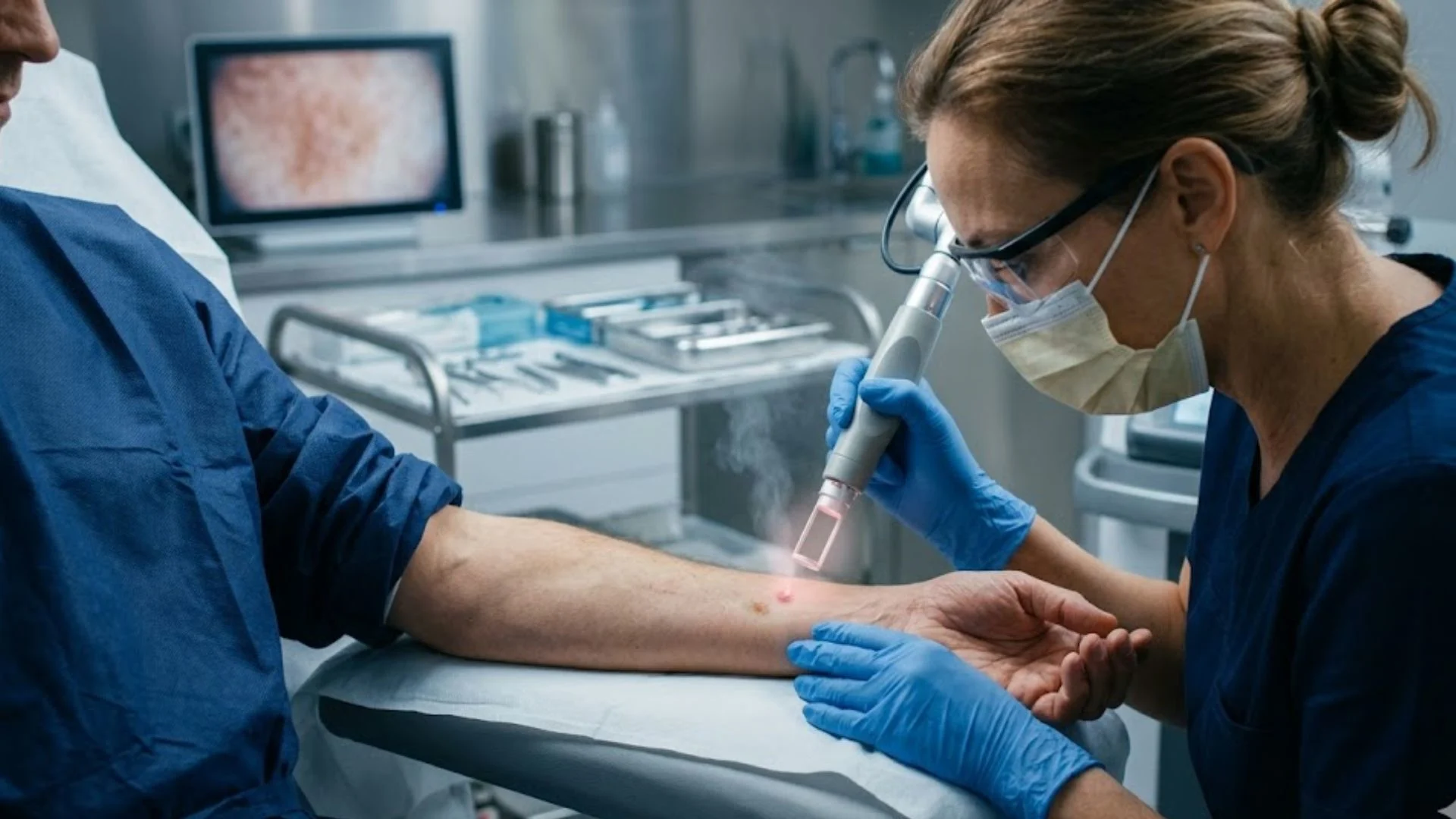
Laser treatment for skin lesions uses focused light to vaporize or break down tissue. Great for seborrheic keratosis, some warts, and vascular lesions like cherry angiomas. Not great for deep stuff or things that need pathology.
3. Topical Treatment for Skin Lesions
Creams. Gels. Lotions. The stuff you slather on at home.
Topical treatment for skin lesions works for certain conditions. Actinic keratosis responds to creams like fluorouracil or imiquimod. Warts can be frozen off or treated with salicylic acid. But don’t go slapping cream on something suspicious. That’s how things get missed.
4. Cryotherapy
Liquid nitrogen. Freeze it. It falls off.
Works great for actinic keratosis, warts, and some benign growths. Quick. Stings like hell for a few seconds. Then you’re done.
5. Electrosurgery and Curettage
Scrape and burn. Sounds medieval. Works beautifully.
They numb the area. Scrape off the lesion. Use an electric needle to stop bleeding and destroy any remaining tissue. Common for basal cell carcinomas and benign growths.
Skin Lesion Diagnosis and Treatment: Why Guessing Is Dangerous
Skin lesion diagnosis and treatment start with one person: a dermatologist.
You walk in. They look. Sometimes they use a dermatoscope—a fancy magnifying glass with a light. They see things your eyes can’t.
“That’s nothing.”
“That’s suspicious.”
“Let’s biopsy that.”
That’s the moment. The fork in the road.
Early treatment for skin lesions matters more than almost anything else. A basal cell that’s a centimeter wide takes five minutes to remove. One that’s five centimeters wide takes surgery. Reconstruction. Recovery.
I watched a friend ignore a spot on her shin for two years. Thought it was just a weird scar. Turned out to be melanoma. She’s fine now—because they caught it before it spread. But she needed a wide excision. Physical therapy. Months of worrying.
Don’t be that person.
Natural Treatment for Skin Lesions: What Works, What Doesn’t
People love natural treatment for skin lesions. I get it. Nobody wants chemicals. Nobody wants knives.
But here’s the truth: Apple cider vinegar doesn’t cure skin cancer.
Home remedies for skin lesions have their place. For warts? Sure. Salicylic acid patches work. Duct tape? There’s actually some evidence that it helps with warts. For benign stuff like skin tags? Tea tree oil might dry them out over time.
But if you’re using natural treatment for skin lesions on something you haven’t had diagnosed, you’re playing a dangerous game.
I had a patient who tried black salve on a spot on her cheek. Black salve is corrosive. It eats skin. She ended up with a hole in her face. The spot she was treating? A benign keratosis. The damage from the salve? Permanent scarring.
Don’t do that.
Natural treatment for skin lesions works for specific, benign, diagnosed conditions. Anything else? See a doctor first. Then go natural if it’s safe.
Prescription Treatment for Skin Lesions: When OTC Isn’t Enough
Prescription treatment for skin lesions is where things get serious.
Your dermatologist writes a script. You pick it up. You follow instructions exactly.
Fluorouracil (Efudex) is the big one. A cream that destroys actinic keratosis. You put it on for weeks. Your skin gets red. It peels. It looks awful before it looks better. But it works.
Imiquimod (Aldara) boosts your immune system to fight off certain lesions. Warts. Some superficial basal cells. Gentler than fluorouracil but still causes reactions.
Tretinoin? That’s for acne and sun damage. Not for lesions you’re worried about.
Prescription treatment for skin lesions requires patience. You can’t rush the process. And you can’t skip the follow-up appointments.
Laser Treatment for Skin Lesions: The High-Tech Option
Laser treatment for skin lesions sounds futuristic. And honestly? It kind of is.
Different lasers for different problems:
- CO2 lasers: Vaporize superficial growths. Seborrheic keratosis. Warts. Some superficial skin cancers in the right cases.
- Pulsed dye lasers: For red things. Cherry angiomas. Rosacea. Spider veins.
- Fractional lasers: For resurfacing. Not really for lesions, but for the damage around them.
The appeal of laser treatment for skin lesions is precision. No cuts. No stitches. Minimal downtime.
The downside? It’s expensive. Insurance usually doesn’t cover cosmetic removal. And if the lesion needs to be biopsied, the laser destroys the tissue. No pathology. No answer.
For known benign lesions? Great option. For anything suspicious? Cut it out. Send it to the lab. Sleep better.
How to Treat Skin Lesions at Home: The Safe Way
People always ask how to treat skin lesions at home. The answer? Carefully.
Safe home options:
- Warts: Salicylic acid patches. Cryotherapy kits. Consistency is key.
- Skin tags: OTC removal bands. Numbing cream first. Follow instructions.
- Minor irritation: Hydrocortisone cream. Clean area. Leave it alone.
- Dry, scaly patches: Moisturizer. Gentle exfoliation. See if it improves.
What not to do at home:
- Cut anything off yourself.
- Use corrosive pastes or salves.
- Ignore something that’s bleeding, growing, or changing.
How to treat skin lesions safely starts with knowing what you’re treating. If you don’t know, don’t treat.
Best Treatment for Skin Lesions: Matching the Method to the Problem
The best treatment for skin lesions is the one that matches the diagnosis.
- Actinic keratosis: Cryotherapy, fluorouracil cream, photodynamic therapy.
- Basal cell carcinoma: Surgical excision, Mohs surgery, curettage, and electrosurgery.
- Squamous cell carcinoma: Surgical excision, Mohs surgery.
- Melanoma: Wide local excision. Lymph node biopsy if needed.
- Warts: Cryotherapy, salicylic acid, laser, cantharidin.
- Seborrheic keratosis: Cryotherapy, laser, curettage.
- Cysts: Surgical excision. Don’t squeeze. You’ll just make it angry.
The best treatment for skin lesions also considers you. Your skin type. Your scarring tendency. Your ability to follow through with aftercare.
Conclusion: Stop Waiting, Start Treating
Here’s the deal. Skin lesions treatment isn’t complicated. You get it checked. You get it treated. You move on with your life.
The people who end up with problems are the ones who wait. The ones who try three home remedies before seeing a doctor.
Don’t be them.
If you have a spot that’s new, changing, bleeding, or just giving you bad vibes, see a dermatologist. Treatment for skin lesions works best when it’s early. When it’s simple. When it’s a ten-minute appointment instead of a surgery.
Your skin is your biggest organ. It tells a story. Sometimes that story needs editing.
Get the edit.
1. What is the most effective treatment for skin lesions?
The most effective skin lesions treatment depends entirely on the type of lesion. For cancerous lesions, surgical excision offers the highest cure rate. For benign lesions like warts or seborrheic keratosis, cryotherapy or laser provides excellent results with minimal downtime. Always get a diagnosis before choosing treatment.
2. Can skin lesions be removed without scarring?
Most skin lesion removal procedures leave some mark, but modern techniques minimize scarring. Laser treatments and careful surgical techniques reduce visible scarring. Your dermatologist can recommend the best approach based on your skin type, the lesion location, and your healing tendencies.
3. How long does it take to recover from skin lesion removal?
Recovery varies by procedure. Cryotherapy and laser treatments typically heal within 1–2 weeks. Surgical excision may take 2–4 weeks for complete healing. Most people return to normal activities immediately.
4. Are there natural ways to treat skin lesions?
Natural treatment for skin lesions works for specific benign conditions. Tea tree oil may help with skin tags. Salicylic acid from plants can treat warts. However, never use unverified natural remedies on undiagnosed lesions. Always get a professional diagnosis before attempting home treatment.
5. How do I know if a skin lesion is cancerous?
The ABCDE rule helps identify suspicious moles: Asymmetry, irregular Borders, uneven Color, Diameter larger than 6mm, and Evolving (changing). Any lesion that bleeds, itches, grows rapidly, or doesn’t heal should be evaluated. Only a dermatologist can confirm through skin lesion diagnosis and treatment with a biopsy if needed.
References
- American Academy of Dermatology. (2024). “Skin Cancer: Types and Treatment.” aad.org
- National Cancer Institute. (2024). “Skin Cancer Treatment (PDQ®)–Patient Version.” cancer.gov
- Journal of the American Academy of Dermatology. (2023). “Guidelines for the Management of Actinic Keratosis.” JAAD, 88(4), 827-841.
- Mayo Clinic. (2024). “Skin Lesions: Diagnosis and Treatment.” mayoclinic.org
- Cleveland Clinic. (2024). “Benign Skin Lesions: Types, Causes, and Treatment.” clevelandclinic.org
- Skin Cancer Foundation. (2024). “Mohs Surgery: The Gold Standard.” skincancer.org
- American Society for Dermatologic Surgery. (2024). “Laser Treatments for Skin Lesions.” asds.net
Read More: Stye Treatment
About the Author