Introduction
Let’s be real. You probably think calcium is just about milk and strong bones. But here’s the thing—your body is weirdly dramatic about it. If you don’t eat enough calcium rich foods, your body literally steals calcium from your bones to keep your heart beating. Yeah. It’s that ruthless.
I learned this the hard way when my aunt—healthy, active, 58—tripped getting out of her car and broke her hip. Just tripped. Her doctor said her bones looked like honeycombs inside. She wasn’t eating enough foods high in calcium. And her body had been quietly robbing her skeleton for years to keep her blood happy.
So I went down a rabbit hole. I talked to dietitians. I read the research from places like Harvard and the NIH. I even tried canned sardines (more on that horror story later). And now I’m sharing the best calcium rich foods that actually don’t suck.
Here’s your calcium rich foods list—the high calcium foods that work, taste decent, and won’t make you feel like you’re eating chalk.
🦴 Calcium power table · top 10 foods per standard serving
| Food (high calcium) | Typical serving | Calcium (mg) | Calories (kcal) | Notes & absorption |
|---|---|---|---|---|
| 🥛 Yogurt, plain low fat | 8 oz (227 g) | 450 mg | ~155 | probiotics + protein. absorb: ~32% |
| 🌱 Tofu (calcium sulfate) | ½ cup (126 g) | 430 mg | ~180 | vegan powerhouse. check label for calcium-set [citation:3][citation:6] |
| 🐟 Sardines, canned w/ bones | 3 oz (85 g) | 330 mg | ~177 | +vitamin D, omega‑3. bones are soft & edible [citation:1][citation:6] |
| 🍊 Orange juice, fortified | 1 cup (240 mL) | 349 mg | ~110 | with calcium citrate-malate. absorb ~30% [citation:2][citation:6] |
| 🥛 Milk, low fat (1%) | 1 cup (244 g) | 310 mg | ~105 | classic. vitamin D usually added. absorption ~32% [citation:3] |
| 🥬 Collard greens, boiled | 1 cup (190 g) | 270 mg | ~63 | low oxalate, high vitamin K. ~49% absorb [citation:3] |
| 🌰 Almonds (whole) | 1 oz (28 g ~23 nuts) | 76 mg | ~164 | + magnesium, vitamin E. 100g = 264mg calcium [citation:1] |
| 🥗 Kale, cooked (not raw) | 1 cup (130 g) | 180 mg | ~42 | super low calorie, oxalate low. ~49% absorb [citation:3] |
| 🐟 Salmon, canned w/ bones | 3 oz (85 g) | 181 mg | ~140 | similar to sardines, +vitamin D. (fillet has almost no Ca) [citation:6] |
| ⏺️ Chia seeds | 1 oz (28 g ~2 tbsp) | 179 mg | ~138 | also magnesium, boron. per 100g = 631mg [citation:1] |
| 📌 Spinach (cooked) * | 1 cup (180 g) | 250 mg | ~41 | high oxalate: only ~5% absorbed [citation:2][citation:6] — combine with other greens |
Why You Should Care About Foods With High Calcium Content
About 99% of it lives in your bones and teeth. The other 1% is running your heart, muscles, and nerves .
Here’s what happens when you don’t eat enough natural sources of calcium: Your body starts a slow, silent robbery. It pulls calcium from your bones to keep your blood levels normal . You don’t feel it. Not at first. But over the years? Your bones become weak. Porous. Fragile.
The National Institutes of Health says most adults need 1,000 mg daily. Women over 50 and men over 70 need 1,200 mg .
But here’s the kicker—you can eat all the calcium in the world and still lose bone if you’re not doing it right. Vitamin D is the key that unlocks calcium absorption. No vitamin D? That glass of milk is basically just expensive water for your bones .
Also? Too much salt, too much caffeine, and smoking? They’re called “calcium thieves” . They literally steal calcium from your body.
The Top 10 Calcium Rich Foods (That Don’t Require a Pharmacy)
1. Sardines (Yeah, The Tiny Fish With Bones)
Okay, hear me out. Canned sardines look terrifying. I know. The first time I opened a tin, my cat was more excited than me.
But here’s the magic—you eat the bones. They’re soft. Edible. You literally can’t feel them. And they’re packed with calcium .
A 3.75-ounce can of sardines gives you about 351 mg of calcium . Plus vitamin D and omega-3s. It’s like a bone health bomb in a tin.
How to eat them: Mash them with lemon, olive oil, and herbs on toast. You’ll feel fancy. Your bones will feel stronger.
2. Dairy Products (The Classics For A Reason)
Milk, yogurt, cheese—they’re not just clichés. One cup of milk gives you about 300 mg of calcium . Plain low-fat yogurt? Up to 448 mg per cup .
But here’s a pro tip: Greek yogurt has slightly less calcium than regular yogurt because of how they make it . Check labels. And always look for “fortified with vitamin D” on the carton.
Hard cheeses are calcium bombs, too. Parmesan has over 330 mg per ounce . That’s insane for something you can grate on pasta.
3. Fortified Tofu (The Vegan Heavyweight)
Tofu is your best friend, if you’re avoiding dairy, . But only if it’s made with calcium sulfate .
Check the ingredients. Some tofu brands skip it. The good stuff? Half a cup can have over 400 mg of calcium .
Quick story: My vegetarian cousin was worried about her bones. She started eating calcium-set tofu three times a week. Her next bone density scan improved.
4. Leafy Greens (But Not All Of Them)
Here’s where people get tricked. Spinach has calcium—about 119 mg per cup. But it also has oxalates, which block absorption . Your body barely gets any of it.
Kale, collard greens, and bok choy? Different story. One cup of cooked collard greens gives you 324 mg of absorbable calcium .
Eat these: Kale, collards, bok choy, turnip greens.
Don’t rely on: Spinach, Swiss chard, beet greens.
Light steaming helps. It reduces oxalates and keeps the nutrients .
5. Fortified Plant Milks (If Dairy Hates You)
Soy milk. Almond milk. Oat milk. Rice milk.
Check the label. You want to be “fortified” with calcium and vitamin D. One cup typically gives you 300–480 mg .
But here’s the catch—shake the carton. The calcium can settle at the bottom . You want that stuff in your glass, not stuck to the container.
Unsweetened is better. Flavored versions often add sugar, which doesn’t help your bones .
6. Canned Salmon (With Bones)
Same idea as sardines. The bones are soft. Edible. You mash them up and don’t notice.
A 3-ounce serving gives you about 180 mg of calcium . Plus vitamin D and protein.
Make salmon patties. Mix with breadcrumbs and egg, and pan-fry. Kids eat them. Adults eat them. Your bones thank you.
7. Beans And Lentils (The Underrated Workers)
Black beans. Chickpeas. White beans. Kidney beans.
They’re not the highest in calcium—about 60–130 mg per cup . But they bring magnesium and potassium, which help calcium do its job .
White beans are the calcium champs here. They’re creamy in soups and stews. Hummus from chickpeas with tahini? Double calcium hit.
8. Nuts And Seeds (Tiny But Mighty)
Almonds: 76 mg per ounce .
Sesame seeds (tahini): 64 mg per tablespoon .
Chia seeds: 179 mg per ounce .
Sprinkle them on everything. Oatmeal. Yogurt. Salads. Toast with almond butter instead of peanut butter boosts calcium by 73 mg per serving .
Pro tip: Soak almonds overnight. It helps your body absorb more calcium .
9. Ragi (Finger Millet)
If you’re from India or have an Indian grocery store nearby, get ragi. It’s a whole grain packed with calcium .
Ragi porridge. Ragi dosa. Ragi roti. It’s comfort food that builds bones.
10. Fortified Orange Juice (The Breakfast Hack)
One cup of calcium-fortified orange juice gives you about 349 mg of calcium . Plus vitamin C, which helps collagen formation in bones .
Check the label. Not all OJ is fortified. And watch the sugar—some brands add a ton.
Calcium Rich Foods For Women (The Hormone Connection)
Women lose bone faster after menopause. Estrogen drop? It speeds up bone breakdown .
Calcium rich foods for women need to be non-negotiable. Yogurt for breakfast. Leafy greens at lunch. Almonds for snacks. If you’re over 50, aim for 1,200 mg daily .
My friend’s mom started drinking fortified soy milk and eating ragi porridge daily. Three years later, her bone density held steady while her friends’ dropped. She calls it her “skeleton insurance.”
Calcium Rich Foods For Pregnancy (Growing A Human)
Pregnancy changes everything. Your baby needs calcium to build their skeleton. If you don’t eat enough, your body steals from your bones .
Pregnant women need 1,000–1,300 mg daily .
Calcium rich foods for pregnancy: Yogurt, fortified plant milk, canned salmon (low mercury), leafy greens, and tahini.
One friend craved orange juice during pregnancy. She drank fortified OJ every morning without realizing she was also protecting her own bones while growing her daughter’s. Two birds, one glass.
Calcium Rich Foods For Kids (Building The Bank)
Childhood and teen years are when you build peak bone mass. Think of it as a bone bank. You deposit now, withdraw later .
Kids 4–8 need 1,000 mg daily. Teens need 1,300 mg .
Calcium rich foods for kids: String cheese, yogurt tubes, smoothies with kale (call it a “Shrek Shake”), and salmon nuggets .
My nephew refuses milk. But he’ll eat frozen yogurt tubes like popsicles. Problem solved.
Dairy And Non Dairy Calcium Foods (Everyone’s Covered)
Lactose intolerant? Vegan? Picky?
Dairy options: Milk, yogurt, cheese, paneer .
Non dairy calcium foods: Fortified tofu, fortified plant milks, canned fish with bones, leafy greens (kale, bok choy, collards), almonds, sesame seeds, beans, ragi, fortified orange juice .
You don’t need dairy to have strong bones. You just need to be intentional.
How To Actually Absorb Calcium (The Science Part)
You can eat all the calcium rich diet foods in the world and still have weak bones if you’re missing these:
Vitamin D: From sunlight, fatty fish, egg yolks, fortified foods .
Magnesium: From nuts, seeds, beans, and leafy greens .
Vitamin K: From leafy greens, especially kale and collards .
Spread it out: Your body absorbs calcium best in doses under 500 mg . Don’t chug a gallon of milk at once. Spread calcium throughout your day.
Avoid thieves: Too much salt, too much caffeine, smoking, and heavy alcohol .
Signs You’re Not Getting Enough
Calcium deficiency is sneaky. It doesn’t scream. It whispers .
- Muscle cramps (especially at night)
- Tingling in fingers
- Weak or brittle nails
- Fatigue
- Bone pain
- Frequent fractures
If this sounds familiar, talk to your doctor. A simple blood test can check.
Calcium Rich Breakfast Foods (Start Right)
Breakfast sets the tone.
Calcium rich breakfast foods:
- Oatmeal made with fortified milk (not water)
- Yogurt with almonds and chia seeds
- Fortified orange juice
- Ragi porridge
- Scrambled eggs with cheese and sautéed kale
- Smoothie with fortified plant milk, spinach, and almond butter
Common Mistakes (Learn From My Dumb Ones)
Mistake 1: Relying on spinach. I thought I was crushing it with huge spinach salads. Turns out, oxalates blocked most of the calcium .
Mistake 2: Forgetting vitamin D. I ate calcium, but stayed indoors. My absorption was probably garbage .
Mistake 3: Downing calcium in one meal. Your body can’t handle 1,000 mg at once. Spread it .
Mistake 4: Ignoring exercise. Bones need weight-bearing exercise—walking, jogging, dancing, lifting—to stay dense .
Foods That Increase Calcium Naturally (The Lifestyle Approach)
Food first. Always. Supplements if your doctor says so .
Whole foods give you calcium plus the helpers—magnesium, vitamin K, protein—that supplements can’t replicate .
And honestly? Eating real food feels better. Tastes better. Makes you feel like you’re taking care of yourself, not just swallowing pills.
Conclusion
Your bones are alive. They’re remodeling every single day. What you eat matters.
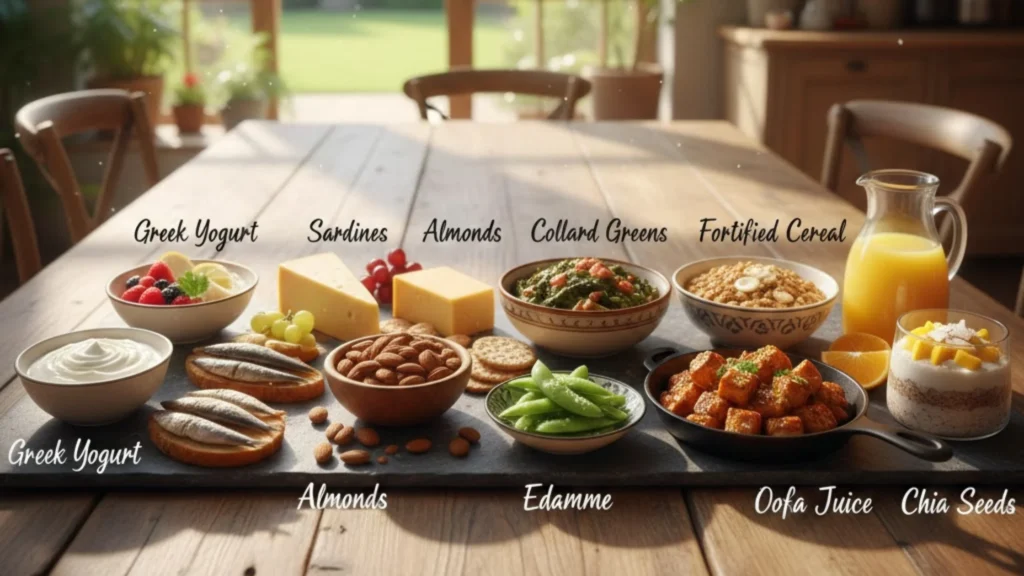
The top 10 calcium rich foods aren’t mysterious or complicated. Sardines. Dairy. Tofu. Leafy greens. Fortified plant milk. Canned salmon. Beans. Nuts and seeds. Ragi. Fortified OJ.
Mix and match. Find what works for your taste and your life.
One last thing: Start now. Not when you’re 60, and your doctor shows you a bone scan that looks like Swiss cheese. Not when you trip and break something. Now.
Your future self—the one walking, dancing, playing with grandkids, staying independent—is counting on you.
Eat the sardines. Drink the fortified milk. And for the love of bones, don’t forget the vitamin D.
Frequently Asked Questions
1. What are the best calcium rich foods if I don’t eat dairy?
Fortified tofu, fortified plant milks (soy, almond, oat), canned sardines and salmon with bones, leafy greens like kale and collards, almonds, tahini, chia seeds, beans, and ragi are all excellent non-dairy options .
2. How much calcium do I actually need daily?
Most adults need 1,000 mg per day. Women over 50 and men over 70 need 1,200 mg. Teenagers need 1,300 mg. Pregnant women need 1,000–1,300 mg depending on age .
3. Can I get enough calcium from plants alone?
Yes. A well-planned diet with fortified plant milks, calcium-set tofu, leafy greens (low-oxalate), nuts, seeds, and beans can meet your needs. Aim for 2–3 servings of calcium-rich plant foods daily .
4. What blocks calcium absorption?
High sodium, excess caffeine, smoking, heavy alcohol, and certain plant compounds like oxalates (in spinach) and phytates (in some whole grains) can reduce absorption. Vitamin D deficiency is the biggest blocker .
5. Should I take calcium supplements?
Food first. Supplements are for when you genuinely can’t meet needs through diet. Talk to your doctor. Too much calcium from supplements can increase kidney stone risk. If you do take them, split doses (500 mg or less at a time) for better absorption .
References:
- National Institutes of Health, Office of Dietary Supplements
- Harvard Health Publishing
- Apollo Hospitals
- UPMC Health Library
- Plant Based Health Professionals UK
- Paras Hospitals
- Nutricia Australia
- Oklahoma WIC
- LifeCell
Read More: Sepsis From Dog Lick
About the Author