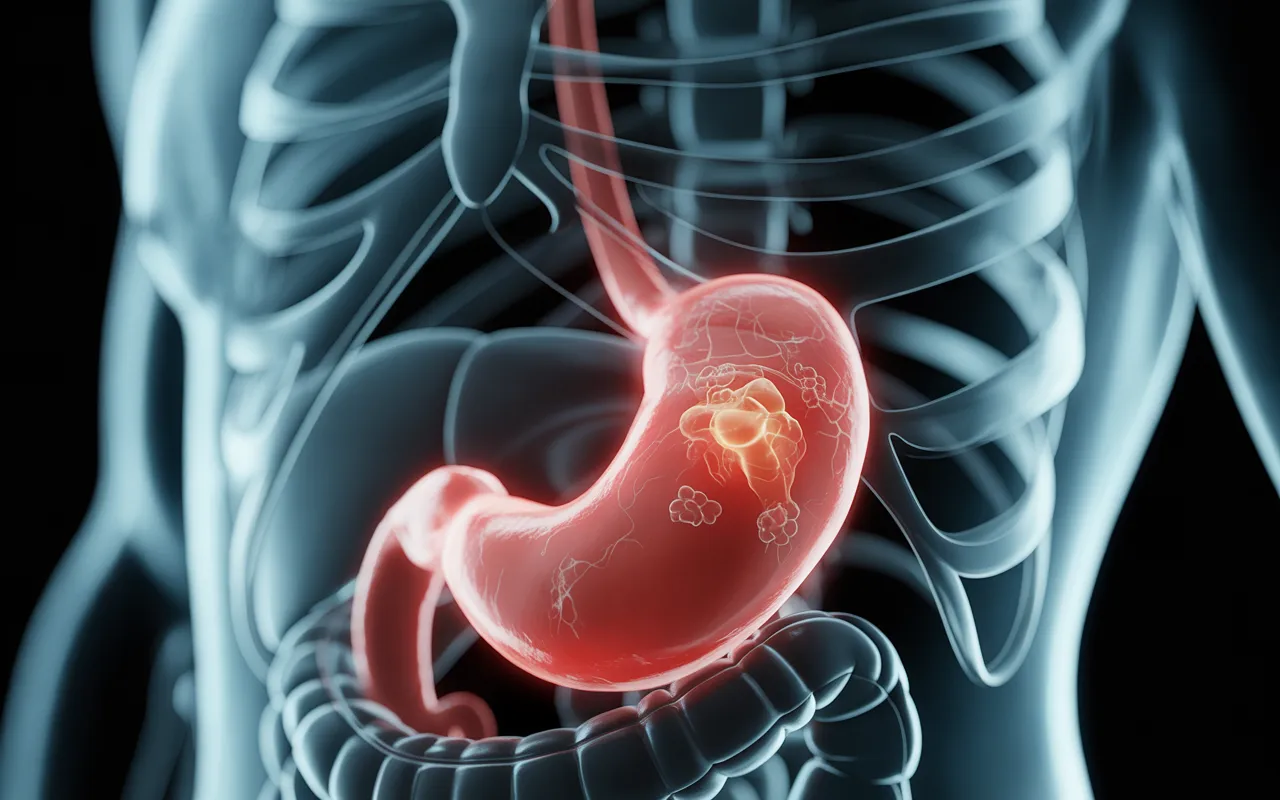
You know that feeling when you eat a gas-station burrito at 2 a.m.? Your stomach throws a fit. It gurgles. It burns. You swear a tiny alien is trying to punch its way out. That’s usually just regret with extra hot sauce.
But what if the punching doesn’t stop? What if the burn stays for weeks, and the burrito was actually a very sad, very healthy salad?
That’s when you stop blaming the food and start asking the scary questions. We’re talking about stomach cancer symptoms. It’s a phrase that sounds heavy, clinical, and terrifying. But ignoring it won’t make it go away. In fact, catching the early symptoms of stomach cancer is the only way to beat the game.
Most people think stomach cancer hits you like a truck. It doesn’t. It creeps in like a bad houseguest. It starts subtly. A little indigestion here. A little bloating there. You tell yourself it’s stress. You tell yourself it’s age. But your body is trying to send you a text message. You just have to read it.
This article isn’t written by a robot. It’s written for real humans who want to know the signs of stomach cancer without needing a medical degree to understand it. We’re going to talk about the whispers your stomach sends before it starts yelling. We’ll cover gastric cancer symptoms, the weird differences between men and women, and why being “too young” isn’t a free pass anymore.
Let’s get into it.
| Symptom | What to do / Supportive measures |
|---|---|
|
1 Persistent indigestion & heartburn
Burning sensation, gnawing discomfort in upper belly; doesn’t improve with antacids or diet changes.
|
|
|
2 Early satiety (feeling full after small meals)
You eat only a few bites but feel stuffed; stomach feels heavy or bloated.
|
|
|
3 Unexplained weight loss & loss of appetite
Dropping pounds without trying; no interest in food, even favorite dishes.
|
|
|
4 Nausea & persistent vomiting
Queasy feeling that lingers; sometimes vomiting undigested food or coffee‑ground‑like material.
|
|
|
5 Abdominal pain & bloating (especially upper abdomen)
Dull ache or pressure under ribs; belly feels constantly swollen or distended.
|
|
The Silent Whisper: Why Early Symptoms of Stomach Cancer Are So Tricky
Here is the dirty little secret about stomach cancer warning signs: they often resemble a bad Tuesday.
I had a neighbor, a guy named Dave. Dave was a concrete worker. Tough as nails. Ate nails for breakfast—probably without milk. He started feeling full after eating only half of his sandwich. He thought he was just getting old. Then came the heartburn. He bought antacids by the pallet. He joked about it. “My stomach is just a drama queen,” he’d say.
Six months later, Dave was sitting in an oncologist’s office. The “drama” was stage 3 gastric cancer.
The tragedy of how to detect stomach cancer early is that the symptoms are masters of disguise. They hide behind common annoyances. If you have a cough, you think cold. If you have a lump, you panic. But if you have a gurgly tummy? You ignore it. We all do.
But there is a difference between a bad day and a bad pattern. Symptoms of gastric cancer in the early stage are persistent. They don’t come and go with the Tums. They stick around. They evolve. They start to feel less like indigestion and more like a weird heaviness that lives right under your rib cage.
Here is the rule of thumb: If your stomach is acting up for more than two weeks and it doesn’t respond to changing your diet or popping antacids, it’s time to stop guessing and start testing.
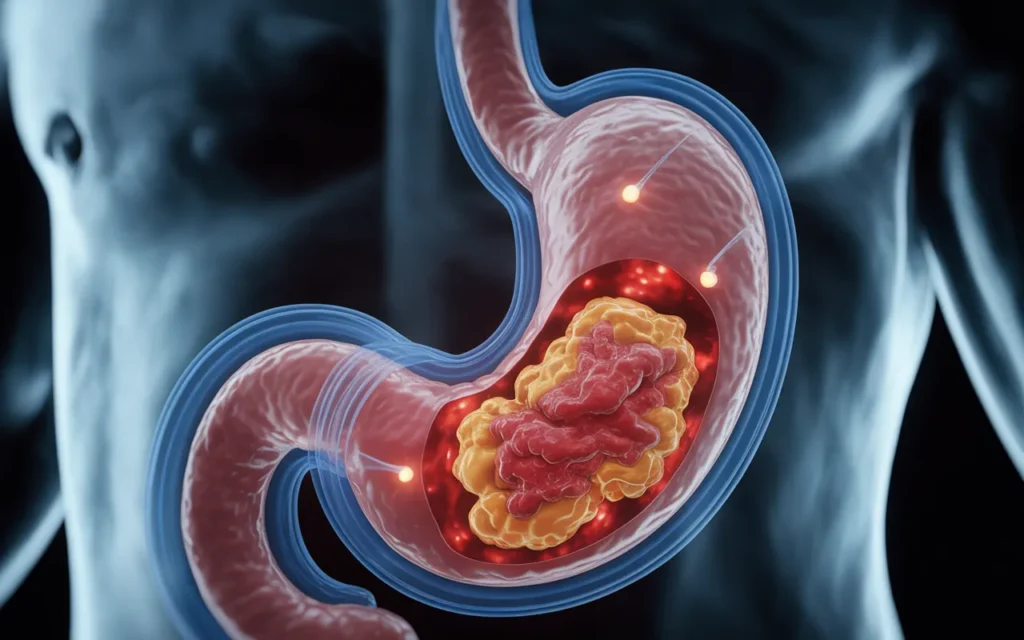
The “Full Feeling” Phenomenon: Early Stage Stomach Cancer Symptoms
Let’s get specific. You’re looking for early-stage stomach cancer symptoms. Not the Hollywood version where you collapse in a restaurant. The real version.
The number one sign that gets missed? Early satiety. Fancy term, simple meaning.
You take three bites of your favorite pizza. You love this pizza. You dreamed about this pizza. But after bite three, your stomach sends a signal to your brain: “We are done. Stop. No more. I am full.”
It feels like you just ate Thanksgiving dinner, but you’re at a Chipotle.
This happens because a stomach tumor can grow in the wall of your stomach, making it stiff. A stiff stomach can’t stretch. If it can’t stretch, it can’t hold food. So, you feel full on a salad.
This is usually accompanied by:
- Bloating: Not the “I ate too much bread” bloat. This is a constant, uncomfortable pressure.
- Indigestion: A gnawing, burning sensation that feels like an ulcer but isn’t.
- Nausea: A low-grade, constant queasiness that makes food look unappealing.
These are the first signs of stomach cancer. They are so boring, so mundane, that we sweep them under the rug. We blame stress. We blame gluten. We blame the weather. But if you are experiencing stomach pain, cancer symptoms that feel like a dull ache rather than a sharp stab, pay attention.
Men vs. Women: Do Stomach Cancer Symptoms Male and Female Differ?
This is where it gets interesting. Does the stomach care if you’re a dude or a lady? Sort of.
Stomach cancer symptoms in male patients tend to present with the classic signs earlier. Guys often notice the bleeding first. If a man has gastric cancer symptoms, he might notice his stool turning black (like tar) before he complains about pain. Men also tend to lose weight faster, likely because they ignore the symptoms until the cancer is already blocking the exit of the stomach.
But stomach cancer symptoms in females are often the ones that get dismissed by—and I hate to say it—both the patient and sometimes the doctor.
Why? Because the female body is used to chaos. Periods cause bloating. Pregnancy causes nausea. Hormones cause fatigue. A woman complaining of stomach cancer symptoms, bloating, is often told, “It’s just your cycle,” or “Maybe it’s anxiety.”
I spoke to a woman in a support group once. She said she went to three different doctors for her stomach cancer symptoms, including indigestion. They gave her diet plans. They gave her antidepressants. One told her to “try yoga.” By the time a doctor finally did an endoscopy (the camera down the throat), she had lost 30 pounds she couldn’t afford to lose.
The moral? Stomach cancer symptoms in adults don’t discriminate, but the healthcare system’s bias often delays diagnosis for women.
The Age Trap: Stomach Cancer Symptoms in Young Adults
We have a mental image of cancer. It’s an old person’s disease. Gray hair. Retirement. We accept it, begrudgingly, for the 70-year-old chain smoker.
But here is the reality check: stomach cancer symptoms at age 30 are a rising trend. It’s rare, but it’s happening more.
I remember scrolling through Reddit and seeing a post from a 28-year-old guy. He was a fitness junkie. Protein shakes. Chicken and rice. He started getting heartburn so bad he couldn’t sleep. He thought he was allergic to whey.
He switched to vegan protein. No change. He started getting stomach cancer symptoms, nausea every morning. His friends joked he was pregnant. He laughed it off.
Six months later, he was diagnosed with signet ring cell adenocarcinoma. It’s an aggressive form. It doesn’t form a lump; it spreads like a sheet through the stomach wall. It’s hard to see. And it’s becoming more common in stomach cancer symptoms in young adults.
If you are under 40 and you have persistent stomach cancer symptoms, vomiting, or blood in your stool, do not let a doctor tell you that you are “too young.” Cancer doesn’t check your ID before it shows up.
Advanced Symptoms: When the Warning Signs Get Loud
If the early signs are whispers, advanced stomach cancer symptoms are a bullhorn.
This is when the situation goes from annoying to urgent.
- Vomiting: Not just nausea. Actual vomiting. Sometimes, if the tumor blocks the stomach, you might vomit food you ate hours ago. It comes up undigested.
- Weight Loss: This is the big one. Stomach cancer symptoms, weight loss isn’t the “I’m trying to get fit” kind. It’s the “my clothes are falling off, and I look gaunt” kind. It happens because the cancer is eating your calories and because you physically can’t eat enough to maintain your weight.
- Blood: You might see blood in your vomit. It might look like coffee grounds (that’s digested blood). Or you might see black, tarry stool. This is internal bleeding.
- Jaundice: If the cancer spreads to the liver (which it often does), your skin and the whites of your eyes might turn yellow.
If you have these warning signs of gastric cancer, you don’t Google it. You go to the ER. You skip the urgent care. You go to the hospital.
The Diagnostic Journey: How to Detect Stomach Cancer Early
Okay, so you’re worried. You have stomach cancer symptoms, bloating, and stomach cancer symptoms, indigestion that won’t quit. What happens next?
You need to get an endoscopy. That’s the gold standard.
Imagine a thin, flexible tube with a camera on the end. You swallow it (or they sedate you so you don’t care). It goes down your throat into your stomach. The doctor looks around.
This is the only reliable way to see stomach tumor symptoms up close.
They might take a biopsy. That’s where they pinch off a tiny piece of tissue to look at under a microscope. This is how they confirm if the signs of stomach cancer are actually cancer or just a bad ulcer.
Here is a gastric cancer symptoms checklist for when you go to the doctor. If you have three or more of these for two weeks, demand a scope:
- Persistent indigestion or heartburn.
- Feeling full after eating very little.
- Unexplained weight loss.
- Nausea or vomiting.
- Black stools.
Don’t walk in and say, “I think I have cancer.” Walk in and say, “I have these symptoms. They aren’t going away. I want to rule out gastric cancer.”
What Causes This? Stomach Cancer Symptoms and Causes
We talk about symptoms, but what actually causes this mess? Stomach cancer symptoms and causes are linked in a frustrating way. It’s not like lung cancer, where you can point to a cigarette.
But there are risk factors.
First, a bacterium called H. pylori. This little bug lives in your stomach. Most people have it and never know. But for some, it causes chronic inflammation. Years of inflammation can lead to changes in the cells. That’s the start of cancer.
Then there is diet. I’m not here to tell you to give up bacon. But diets high in smoked foods, salted fish, and pickled vegetables (common in certain cultures) have higher rates. Fresh fruits and vegetables seem to act like a shield.
Genetics plays a role. If your parent or sibling had it, your risk goes up.
And then there is the random factor. Sometimes, there is no reason. No bad diet. No bacteria. Just bad luck.
It’s important to look at stomach cancer symptoms mayo clinic resources if you want the clinical breakdown, or check stomach cancer signs and symptoms NHS for a UK perspective. Both are reputable, no-nonsense resources that cut through the noise.
The Misdiagnosis Trap: Don’t Settle for “It’s Just Acid Reflux”
Here is a raw truth. The medical system is overloaded. Doctors are human. They see 50 patients a day. They are trained to look for horses, not zebras. But sometimes, you’re a zebra.
If you have stomach pain or cancer symptoms, it’s easy for a doctor to say, “Here’s some Omeprazole. Come back in three months.”
If you have stomach cancer symptoms, nausea, and stomach cancer symptoms vomiting, it’s easy to blame a virus.
If you have stomach cancer symptoms in adults that are vague, it’s easy to say it’s anxiety.
I’ve seen it happen. A friend of mine, a 45-year-old father of two, was told he had GERD for a year. He kept going back. He kept saying, “The meds aren’t working.” Finally, he went to a different hospital. They did an endoscopy within a week.
It was cancer. Stage 2.
He’s okay now. He’s alive. But he had to advocate for himself. He had to be annoying. He had to be the patient who wouldn’t take “it’s nothing” for an answer.
If the treatment for indigestion isn’t working, something else is going on. Don’t let time slip away.
Actionable Tips: Taking Control of Your Gut Health
We can’t control our genetics. But we can control how we respond to our bodies.
1. Know Your Baseline
What does normal feel like for you? If you normally can eat a whole pizza and suddenly you’re full after one slice, that’s a change. Document it. Write it down. “October 12: Full after 3 bites. October 13: Nausea in the morning.” Doctors love data. It makes them listen.
2. Look at the Toilet
I know it’s gross. Look anyway. Stomach cancer symptoms often show up in the bowl. Black, tarry stool? That’s blood. That’s a sign of bleeding somewhere in the upper GI tract. Don’t flush that evidence away.
3. Check Your Family Tree
If grandma had it, you would need to be screened earlier. How to detect stomach cancer early often relies on family history. If you have a first-degree relative (parent, sibling) who had gastric cancer symptoms, you should be getting scoped 10 years before their age of diagnosis.
4. Trust the Weird Feeling
You know your body. You know when something is off. That nagging feeling that your stomach is just… different? That’s your gut instinct. Literally. Trust it.
Conclusion: Your Stomach is Talking. Are You Listening?
Look, I’m not a doctor. I’m just a writer who has seen too many people shrug off stomach cancer symptoms until it’s too late. I’m the guy who tells you to stop being a hero and start being a patient.
The early symptoms of stomach cancer are boring. They are annoying. They are easy to ignore. It just gives them time to grow.
If you have persistent indigestion that won’t quit, if you are losing weight without trying, if you feel like a balloon is stuck under your ribs—make the call. Schedule the scope.
It might be nothing. It probably is nothing. But in the off chance it is something, catching signs of stomach cancer at stage 1 is a completely different ballgame than catching it at stage 4.
Don’t be Dave. Don’t buy the antacids by the pallet. Be the person who gets it checked out, gets it treated, and lives to tell the story.
Your stomach is doing a lot for you. Show it some respect. Listen to it.
Frequently Asked Questions (FAQs)
1. Can you have stomach cancer without feeling pain?
Yes. In fact, stomach pain and cancer symptoms often don’t appear until the later stages. Early gastric cancer symptoms usually present as discomfort, bloating, or indigestion rather than sharp pain. This is why it’s often called a “silent” disease in the early phases.
2. What does stomach cancer poop look like?
If you have stomach cancer symptoms, your stool may appear black, tarry, and sticky. This is called melena. It occurs when there is bleeding in the stomach or upper intestines, and the blood is digested as it passes through the bowels.
3. How long can you have stomach cancer without knowing?
Because the early symptoms of stomach cancer mimic common issues like indigestion, people can live with the disease for months or even a year without a correct diagnosis. The tumor can grow significantly before it causes enough disruption to force a patient to seek specialized care.
4. Are the symptoms of stomach cancer different for men and women?
While the core stomach cancer symptoms male and female experience are similar (bloating, nausea, weight loss), stomach cancer symptoms female are often dismissed as gynecological issues or anxiety, leading to later diagnosis. Women should be especially vigilant about persistent bloating that doesn’t correlate with their menstrual cycle.
5. Is there a screening test for stomach cancer?
Yes. The most accurate way to detect stomach cancer early is through an upper endoscopy (EGD). This procedure involves a thin, flexible camera being inserted down the throat to visually inspect the stomach lining. There is no simple blood test or at-home screening kit that reliably detects stomach tumor symptoms in the early stages.
References & Resources
- American Cancer Society. (2024). Stomach Cancer Signs and Symptoms. Retrieved from cancer.org
- Mayo Clinic. (2024). Stomach cancer – Symptoms and causes. Retrieved from mayoclinic.org
- National Health Service (NHS). (2024). Stomach cancer symptoms. Retrieved from nhs.uk
- National Cancer Institute. (2024). Gastric Cancer Treatment (PDQ®)–Patient Version. Retrieved from cancer.gov
Read More: Stomach Virus
About the Author