What Actually Is Healthcare Data Annotation? (The No-Jargon Version)
Imagine teaching a toddler what a cat looks like. You point at pictures. You say “cat.” Over and over until the kid gets it.
Medical annotation is exactly that. Except the toddler is a computer. And the pictures are X-rays. And instead of cats, you’re pointing at tumors, fractures, and weird-looking organs.
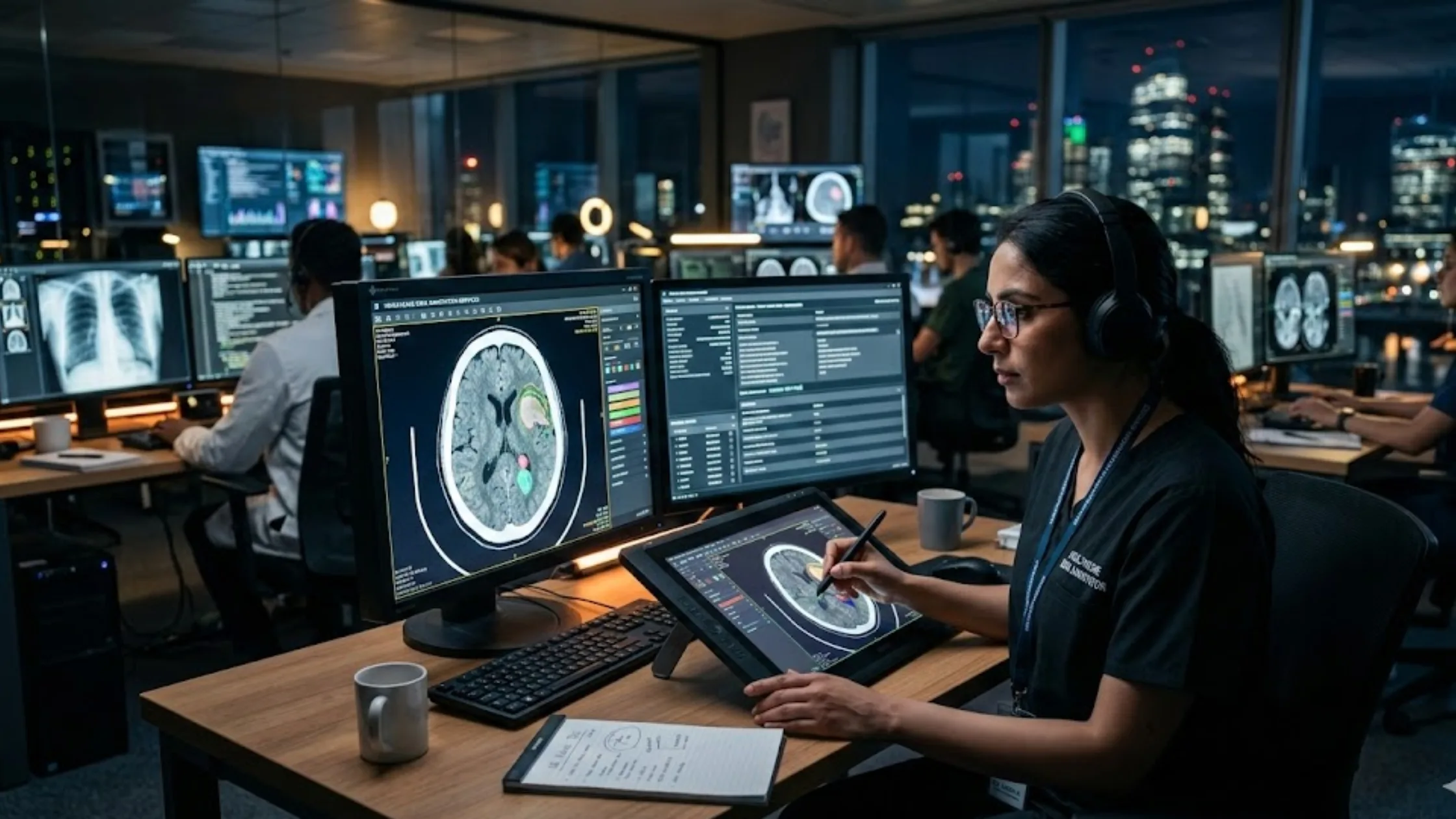
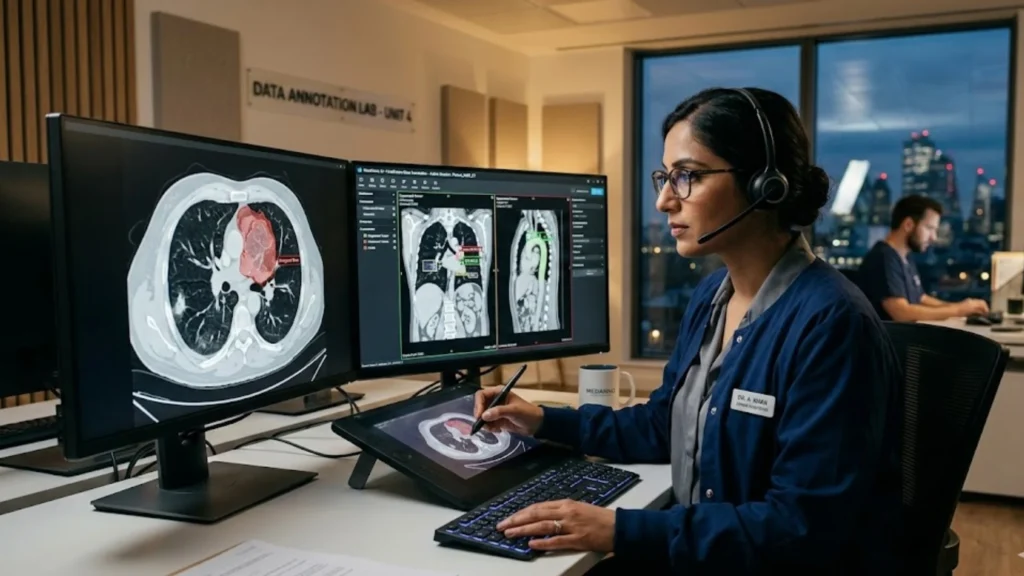
Healthcare data annotation services do one thing: they take raw medical stuff (images, reports, recordings) and add labels that machines understand. A radiologist might spend hours drawing polygons around a lung nodule. That polygon becomes a medical image annotation. The computer learns. Eventually, it can find nodules on its own.
Sounds simple, right?
It’s not.
Why It’s Actually Hard
Here’s what makes medical labeling different from tagging Facebook photos :
| Regular Image Labeling | Medical Image Annotation |
| JPG, PNG files | DICOM, NIfTI formats |
| 2D photos | 3D volumes, multi-slice scans |
| 8-bit color | 16-bit (65,000+ values) |
| Anyone can do it | Needs doctors |
| No rules | HIPAA. Always HIPAA |
I talked to an annotator once. She told me about spending three weeks on a single brain MRI dataset. Three weeks. Drawing tiny lines around structures that most people don’t even know exist. She said her eyes crossed by day two.
But here’s the thing. Without her work, the AI would be useless. Actually worse than useless. It would be dangerous.
⚕️ Healthcare Data Annotation Services 2026 Technical Specification
Expert-led annotation, regulatory compliance (FDA/HIPAA/GDPR), imaging & text · Platform vs. workforce · Audit-ready & certified medical professionals. Verified Q2 2026.
| Company / Platform | Medical domain experts (in-house) | Supported data types (healthcare) | Compliance & security | Accuracy / QA process | Key differentiator | Best use case |
|---|---|---|---|---|---|---|
| iMerit + Ango Hub | ✅ Board-certified radiologists, pathologists, nurses, certified coders, transcriptionists [citation:1] | Imaging (DICOM), pathology, ambient scribe, EHR, clinical text, coding, genomics [citation:1][citation:6] | HIPAA, ISO 27001, SOC2, GDPR, CFR 21 Part 11, GxP-aligned, audit trails, PHI [citation:1][citation:6] | Reasoning capture, multi-stage QC, physician benchmarking, 20M+ healthcare data points [citation:1][citation:5] | Audit-ready traceability + regulatory submission focus (FDA/CE) | Regulatory-grade AI, diagnostic models, full traceability required |
| Scale AI | Limited in-house medical experts; generalist + RLHF [citation:1] | Multimodal: text, audio, image, video, DICOM (basic) [citation:1] | HIPAA, SOC2, GDPR; but lacks CFR21 & audit-ready pipelines [citation:1][citation:6] | High-throughput with model-assisted, human QA, but no clinical reasoning capture [citation:1] | API-first, automation, RLHF for summarization/coding | Large-scale NLP/general healthcare text, not critical imaging |
| SuperAnnotate | Medical professionals available via marketplace, not internal full-time [citation:1][citation:9] | Imaging, video, text, DICOM support, 3D segmentation [citation:1][citation:5][citation:10] | HIPAA, SOC2 Type2, ISO 27001; but no CFR21 or GxP workflows [citation:5][citation:6] | Tool-assisted QA, versioning; relies on external experts [citation:1] | High-precision visual AI tools, strong computer vision automation | Computer vision teams, medical imaging with own experts |
| Dataloop | No dedicated in-house medical staff; customer configures [citation:1] | Text, audio, document, image, video; supports DICOM via customization [citation:1] | Enterprise-grade, HIPAA possible with self-setup, no out-of-box medical validation [citation:1] | Model-in-the-loop, QA automation, but no medical reasoning capture [citation:1] | Highly customizable pipelines, SDK flexibility | Technical teams building custom medical workflows |
| Sama | ✅ Domain-specific pipelines incl. healthcare, but limited public detail on in-house clinicians [citation:1] | NLP, imaging, video, some medical imaging projects [citation:1] | HIPAA compliant, ISO27001, but no CFR21 / GxP [citation:1][citation:6] | Human QA teams, multilingual, lacks clinical-grade validation tools [citation:1] | Ethical AI + social impact workforce | Moderate complexity healthcare datasets with social mission |
| Shaip | Clinical experts, radiologists, physicians, medical coders [citation:5][citation:9] | Medical imaging (X-ray, CT, MRI, histopathology), clinical text/NLP, speech [citation:5][citation:9] | HIPAA, GDPR, ISO27001, de-identification, privacy-first [citation:5][citation:6] | Clinical validation by healthcare professionals, multi-stage QC [citation:5] | Deep healthcare focus + global team of clinicians | Regulated healthcare AI, clinical NLP, telemedicine |
| CloudFactory | Trained annotation teams, but not board-certified clinicians – focus on process [citation:5][citation:9] | Medical imaging (X-ray, MRI, CT), document AI, NLP [citation:5] | SOC2, HIPAA, GDPR, ISO27001; long-term partnerships [citation:5] | Process-driven QA, 8M+ annotation hours, consistent throughput [citation:5] | Operational stability + hybrid human‑in‑loop | High-volume medical imaging & document processing |
| Anolytics | 1200+ in-house annotators + medical professionals across specialties [citation:5] | X-ray, CT, MRI, ECG, ultrasound, semantic seg, bounding boxes [citation:5] | HIPAA compliant, secure data handling [citation:5] | High-volume annotation with medical oversight, polygonal/3D point cloud [citation:5] | Scalable medical-dedicated workforce | High‑volume, multi-modal medical imaging |
| 汇众天智 (Huizhong Tianzhi) | 专属医疗背景团队, 临床术语专家, 肿瘤/心血管报告 [citation:2][citation:3] | 医疗文本语义分割, 实体识别, 影像辅助, 电子病历 [citation:2] | L3数据保密资质, ISO9001, 两化融合, 等保2.0, 医疗数据规范 [citation:2][citation:3] | 四级质检: 初标-复标-交叉-终审, 准确率99.2%+ [citation:2] | 电力/金融级安全 + 垂直医疗文本深度 | 中文医疗文本, 敏感数据, 政企项目 |
| Frekil | Certified & benchmarked radiologists (global marketplace) [citation:4] | Medical imaging: X-ray, CT, MRI, ultrasound, pathology; DICOM, NIfTI [citation:4] | FDA‑ready annotation versioning, audit trails, compliance-focused [citation:4] | AI‑assisted annotation, multi‑stage reviews, consensus & performance tracking [citation:4] | Built by IIT Bombay alumni, radiologist-exclusive | Radiology AI, diagnostic startups, fast turnaround imaging |
Medical Image Annotation: Where Pixels Become Diagnoses
Let’s get specific. Medical image annotation is the heavyweight champion of healthcare data work. Think X-rays, CT scans, MRIs, and ultrasounds. All that stuff doctors stare at.
The numbers are nuts. The FDA has authorized 882 AI-enabled medical devices as of mid-2024. Most are in radiology . That means 882 different algorithms, all trained on annotated images.
DICOM and NIfTI Image Labeling: Speaking the Machine’s Language
Hospitals don’t use JPEGs. They use DICOM and NIfTI image labeling formats. DICOM stands for Digital Imaging and Communications in Medicine. Fancy name. Simple idea: it’s a file that carries both the image AND patient data, scanner settings, hospital info .
Here’s what makes DICOM and NIfTI image labeling tricky. A single “image” might actually be 58 slices through someone’s chest. Each slice is 2D. Together, they make a 3D volume. Annotators have to label in all three planes: axial (top-down), sagittal (side), coronal (front).
I watched a pro do this once. She’d mark a tumor on slice 23. The software would interpolate slices 24-27. Then she’d check everything and fix the mistakes. It looked exhausting.
X-ray and MRI Segmentation: Drawing the Lines
X-ray and MRI segmentation is exactly what it sounds like. You segment. You separate. You draw boundaries between healthy tissue and bad stuff.
There are different tools for this :
- Bounding boxes: Quick rectangles around problem areas. Good for rough localization.
- Polygons: Precise shapes that follow actual organ contours. Takes forever, but worth it.
- Brush tools: Paint over areas like a digital paintbrush. Great for irregular shapes.
- Keypoints: Mark specific spots. Useful for joints, measurements, and tracking changes.
A friend in the industry told me about a lung cancer project. They needed CT scan annotation services for 10,000 images. Each image required pixel-perfect segmentation of nodules, blood vessels, and airways. The team? Seven radiologists are working for six months. Cost? Over half a million dollars.
CT Scan Annotation Services: 3D Is a Whole Different Beast
CT scan annotation services deserve their own category. CTs are dense. Hundreds of slices per patient. Annotators scroll through layers, marking structures slice by slice.
Some platforms now offer 3D annotation tools . You can label in one view, and the software projects your marks across all dimensions. It’s beautiful when it works. When it doesn’t, you’re fixing mistakes across 200 slices.
Ultrasound Image Tagging: Moving Targets
Ultrasound image tagging adds another headache: motion. Fetuses move. Hearts beat. Blood flows. Annotators have to track structures across time.
One ultrasound video might have thousands of frames. Labeling every frame is impossible. So teams label key frames, then use interpolation algorithms to fill gaps. Then they check everything manually .
Clinical Data Annotation: It’s Not Just Pictures
Look. Medicine isn’t all images. There’s text too. Mountains of it.
Clinical data annotation deals with everything else: doctors’ notes, discharge summaries, lab reports, and clinical trial data. This stuff is messy. Doctors write fast. Their notes are half-finished sentences, abbreviations, and rushed observations.
Electronic Health Record (EHR) Data Tagging
Electronic Health Record (EHR) data tagging is like cleaning a teenager’s room. You dig through chaos, find what matters, and organize it.
EHRs contain:
- Patient histories
- Medication lists
- Allergy warnings
- Lab results
- Doctor observations
- Billing codes
All of it is unstructured. All of it is useful.
A 2026 study showed that NLP systems analyzing discharge summaries found twice as many adverse drug reactions as traditional reporting methods . Twice. Because patients tell doctors things they don’t tell reporting systems.
Medical Named Entity Recognition (NER)
Medical Named Entity Recognition (NER) is the tech term for “find the important stuff.” Drugs. Conditions. Doses. Dates. Symptoms.
An NER system reads a note like “Patient reports headache after taking Lisinopril 10mg yesterday” and tags:
- Lisinopril → Drug
- 10mg → Dose
- headache → Symptom
- yesterday → Timing
This matters because adverse drug reactions kill people. Seriously. They’re a major cause of hospital admissions and in-hospital deaths . But they’re underreported. Doctors don’t always file reports. NLP finds what gets missed.
Medical Transcript Annotation
Medical transcript annotation handles dictated notes. Doctors talk. Software transcribes. Annotators clean up and tag.
Voice recognition messes up medical terms. “Atrial fibrillation” becomes “a tree fills a brillation.” Annotators fix that. They also add structure: this section is history, this section is assessment, this section is plan.
Clinical Sentiment Analysis
Here’s one that sounds weird. Clinical sentiment analysis? Are we analyzing how patients FEEL?
Yes. Exactly.
Patient messages, survey responses, and even doctor notes contain emotional content. Depressed patients describe pain differently. Anxious patients overreport symptoms. Understanding sentiment helps AI interpret data in context .
Healthcare NLP Labeling: Teaching Machines Medical Language
Healthcare NLP labeling deserves its own spotlight. Language is messy. Medical language? Even messier.
Consider “cold.” Does that mean temperature? A virus? The opposite of hot? Context matters.
The QUADRATIC Study: Real Results
Let me tell you about QUADRATIC. It’s a pharmacovigilance project in Switzerland . Researchers wanted to catch adverse drug reactions automatically. They trained NLP on 400 discharge summaries.
Results? Logistic regression with simple word counting beat fancy deep learning. Sometimes, simple works. The system found twice as many confirmed drug reactions as old-school regex methods .
That’s clinical data annotation saving lives. Not through fancy algorithms. Through good training data.
Who Actually Does This Work? (The Humans Behind the Screens)
You might think AI annotates itself. Nope. Healthcare data annotation services still need humans. Lots of them.
The Expert Problem
Regular data labeling? Anyone can do it. Show someone a cat picture, and they can draw a box around the cat.
Medical labeling? Different story .
Ask a random person to find a tumor on an MRI. They’ll stare at grey blobs. Even doctors sometimes disagree. Studies show inter-annotator agreement varies wildly depending on the task .
That’s why companies like iMerit use board-certified radiologists, pathologists, nurses, and medical coders . Not crowdsourced workers. Actual medical professionals.
Training and Quality Control
Quality control in medical annotation is brutal :
- Multi-annotator review: Two or three people label the same image
- Consensus voting: Algorithms decide which label is probably right
- Expert adjudication: Senior doctors settle disagreements
- Continuous auditing: Random samples get rechecked forever
One pathology project used 280,000 human markups across multiple institutions . That’s the scale we’re talking about.
Tools of the Trade: What Annotators Actually Use
Software matters. You can’t label DICOM files in Photoshop. It won’t work.
What Good Medical Annotation Tools Do
- Load massive files (50MB+ per image)
- Handle 3D volumes smoothly.
- Support DICOM and NIfTI formats.
- Offer window/level adjustments (radiology brightness controls)
- Provide segmentation tools that actually work.
- Track every click for audit trails.
- Encrypt everything for HIPAA.
The Tool Landscape
Unitlab AI: Fast, scalable, good automation. Freemium model .
Encord: End-to-end platform. Strong on medical imaging. Used by hospitals .
V7 Darwin: Speed-focused. Keyboard-driven. Auto-annotation helps with repetitive tasks .
MD.ai: Built for radiologists. Feels like clinical PACS systems. Great for teaching .
Labelbox: Cloud-based. Model-assisted labeling. Strong QA .
Napari: Open source. Python-based. For researchers who code .
The Open Source Trade-off
Napari is free. But you need to build everything yourself. Plugins exist for DICOM, segmentation, and 3D visualization. But configuring it takes developer time .
Sometimes paying for a tool is cheaper than building your own workflow.
The Data Problem: Where Does It Come From?
Here’s the nightmare. Medical data is private. Protected. Regulated. You can’t just scrape it from the internet.
HIPAA and Compliance
In the US, HIPAA rules everything . Protected Health Information (PHI) includes:
- Names
- Dates (except year)
- Phone numbers
- Fax numbers
- Email addresses
- Social Security numbers
- Medical record numbers
- Health plan numbers
- Account numbers
- Certificate numbers
- License numbers
- Vehicle identifiers
- Device identifiers
- IP addresses
- Biometric data
- Face photos
- Any unique identifying code
All that has to go before the data gets annotated. Or annotators need signed authorizations. Either way, it’s paperwork hell.
Synthetic Data: The Workaround
Some teams generate synthetic data . Artificial patients. Artificial diseases. Artificial scans.
RadImageGAN creates synthetic medical images with auto-labeled masks. BigDatasetGAN does similar stuff. The advantage? No privacy concerns. You can generate unlimited training data.
The disadvantage? Synthetic isn’t real. Models trained on synthetic data sometimes fail on real patients. It’s getting better, though.
Public Datasets
There are public options :
- Medical Segmentation Decathlon: 10 segmentation tasks, labeled volumes
- AbdomenAtlas: 20,460 CT volumes, 673,000+ masks
- PadChest: 160,868 chest X-rays with Spanish reports
- ROCOv2: 79,789 radiology images with concept labels
But public datasets are generic. If you need something specific, you’re collecting your own.
Why Quality Matters More Than Quantity
Here’s a mistake companies make. They think more data = better AI.
Nope.
Bad data = bad AI. Period.
The Garbage Problem
I heard about a startup that scraped millions of chest X-rays from public sources. They annotated cheaply. Outsourced to non-medical people. Saved money.
Their pneumonia detector failed. Miserably. It confused pacemakers with lung infiltrates. It missed actual pneumonia. Because the annotators didn’t know anatomy. They just drew boxes where they were told.
The company folded.
Active Learning: Smarter Annotation
Smart teams use active learning . The algorithm picks which samples need labeling. It finds its own weaknesses. It asks humans for help on the hard stuff.
This is NIH-funded research. Real science. Active learning reduces annotation work by focusing on valuable examples instead of random selection .
Real-World Example: Phlebotomy Training Data
Let me give you a concrete example. Researchers created 11,884 labeled images of simulated blood draws . They used a training arm (a fake arm for practice). Cameras recorded everything.
Annotators drew polygons around five things:
- Syringe
- Rubber band
- Disinfectant wipe
- Gloves
- The training arm itself
Why? To train an AI that teaches medical students. The AI can watch students practice and give feedback: “You missed the vein.” “Your angle is wrong.” “Sterilize better next time.”
That’s healthcare AI training data in action. Not diagnosing disease. Teaching future doctors. Both matter.
Current Trends Shaping the Industry
AI-Assisted Annotation
Tools now offer AI pre-labeling . The algorithm guesses. Humans correct. This cuts time by 50-80%.
But there’s a trap. If the AI is wrong consistently, humans stop correcting. They get lazy. Quality drops. Good workflows randomize samples and audit constantly .
Foundation Models
The Bigpicture project is training foundation models on millions of pathology slides across Europe . These models understand general pathology. Then they fine-tune for specific tasks.
Think of it like teaching a kid biology before specializing in heart surgery. Foundation models learn the basics. Then specialized data adds expertise.
Privacy-Preserving Techniques
Federated learning lets hospitals train models together without sharing patient data . The model travels. The data stays put. Brilliant solution.
Synthetic data is improving, too. Generative AI creates realistic but fake patients. No privacy violations. Infinite training data .
Tariff Impacts
Here’s something random. Tariffs on servers affect annotation . Cloud costs go up. Companies rethink infrastructure. Some move back to on-premises. Others diversify vendors.
Supply chains matter even in data work.
The Cost Reality
Let’s talk money.
Market size: $1.51 billion in 2025. Projected $3.63 billion by 2032. 13.34% CAGR .
What do you actually pay?
- Simple bounding boxes: cheaper
- Complex segmentation: expensive
- Expert radiologists: very expensive
- NLP annotation: depends on document complexity
- 3D volume labeling: costs add up fast
One company quoted $50 per CT scan for basic tumor annotation. Complex multi-structure segmentation? $200-500 per scan. For a dataset of 10,000 scans, do the math.
Common Mistakes (Learn From Others)
Mistake 1: Skipping Domain Experts
You can’t have non-medical people labeling medical images. They miss things. They misinterpret. They introduce errors that kill model performance .
Mistake 2: Ignoring Inter-Annotator Agreement
If your annotators disagree constantly, your data is garbage. Measure agreement. Investigate disagreements. Fix guidelines .
Mistake 3: Forgetting About Drift
Medical practice changes. New guidelines. New discoveries. Five-year-old annotations might be wrong now. Refresh datasets periodically .
Mistake 4: Skimping on Metadata
A bounding box without context is weak. Who annotated it? When? What were the guidelines? What was their confidence? Good datasets include this .
How to Choose an Annotation Partner
If you’re outsourcing, here’s what matters :
Medical expertise: Do they employ actual clinicians? Board-certified ones?
Compliance: HIPAA? ISO 27001? SOC 2? GDPR? Ask for certificates.
Quality processes: How do they measure accuracy? What’s their review workflow?
Traceability: Can they show who did what, when, and why?
Scalability: Can they handle your volume without crashing?
Platform: Do they provide tools, or just services? Tools usually mean better quality control.
Provider Comparison Snapshot
| Provider | Medical Experts | Compliance | Traceability | Best For |
| iMerit | Yes (board-certified) | HIPAA, ISO, SOC2 | Full audit trails | Complex clinical AI |
| Scale AI | Limited | Basic | Limited | High throughput |
| SuperAnnotate | No | Basic | None | General computer vision |
| Dataloop | No | Yes | Partial | Teams with internal experts |
| Sama | Yes | Yes | Partial | Multilingual projects |
| Toloka | No | No | None | Simple non-medical tasks |
The Future (Next 5 Years)
Multi-Modal Annotation
Future datasets combine everything: images, text, audio, and video . A patient record includes scans, notes, conversations, and vital signs. AI needs all of it.
Real-Time Annotation
Some tools now offer real-time collaboration . Multiple annotators work on the same case. Supervisors jump in to resolve disputes. Chat, comment, fix. All live.
Automated Quality Metrics
Continuous measurement replaces periodic audits . Every annotation gets scored. Drift gets detected instantly. Problems fixed immediately.
Clinical Integration
Annotation moves into clinical workflows . Pathologists annotate as part of diagnosis. The data serves both patient care AND future AI training. Win-win.
Read More: Stomach Virus
About the Author