GLP-1 drugs have taken over the world. You’ve seen the headlines. You’ve heard the stories. Maybe you’re thinking about starting medication yourself. But what’s the real deal?
Here it is.
These aren’t magic bullets. But they are pretty darn close.
GLP-1 receptor agonists were first made to help with type 2 diabetes. Then, doctors noticed something wild. People taking them weren’t just controlling their blood sugar. They were shedding serious pounds. Fast forward to today, and GLP-1 for diabetes has evolved into a blockbuster obesity treatment medication. It’s a game-changer. But like any powerful tool, you need to know how to use it without hurting yourself.
Stick with me. I’ll tell you exactly how GLP-1 works, what the benefits are, and the brutal side effects no one talks about at the water cooler.
| Drug (Generic / Brand) | Type / Mechanism | Half-Life (t½) | Bioavailability | Clearance / Metabolism | Key Notes |
|---|---|---|---|---|---|
|
Semaglutide Ozempic® / Wegovy® / Rybelsus® (oral) |
GLP‑1 receptor agonist (94% homology to human GLP‑1) Acylated analog with C18 diacid |
~7 days (once-weekly SC) |
SC: ≈89% Oral: 0.5–1% (with SNAC enhancer) |
Clearance: proteolysis; urine/feces elimination. SC clearance ~0.05 L/h | Longest half-life Weight loss up to 15% Oral form requires strict fasting. |
|
Liraglutide Victoza® / Saxenda® |
GLP‑1 analog (97% homology) Fatty acid acylation (C16) |
~13 hours (once-daily SC) |
≈55% (subcutaneous) | Clearance ~1.2 L/h; partially renal + proteolytic degradation | Daily dosing First GLP‑1 approved for obesity. Cardiovascular benefit proven (LEADER trial). |
|
Dulaglutide Trulicity® |
GLP‑1–IgG4 Fc fusion protein Two GLP‑1 molecules linked to Fc fragment |
~5 days (once-weekly SC) |
42%–65% (subcutaneous) | Clearance ~0.142 L/h; slow elimination via catabolism | Steady state after 2–4 doses Lower risk of hypoglycemia. Reduces MACE events. |
|
Exenatide Byetta® / Bydureon® (once-weekly) |
Synthetic exendin‑4 (53% homology) Resistant to DPP‑4 degradation |
2.4 hours (IR) 6–7 days (ER formulation) |
N/A (rapid absorption) | Clearance ~9.1 L/h; glomerular filtration + proteolysis | Shortest half‑life (IR) Twice‑daily injection for Byetta. Bydureon weekly microspheres. |
|
Tirzepatide Mounjaro® / Zepbound® |
Dual GIP/GLP‑1 receptor agonist First‑in‑class dual incretin |
~5 days (once-weekly SC) |
≈80% (estimated) | Slow elimination; half‑life 120–150h. Metabolized via proteolysis. | Superior weight loss: 15–20% Dual pathway Improved glycemic control vs GLP‑1 alone. |
|
Lixisenatide Adlyxin® / Lyxumia® |
Exendin‑4 based GLP‑1 agonist C‑terminal deletion + 6 Lys residues |
~3–4 hours (once-daily SC) |
Not fully established | Renal clearance dominates; proteolysis | Short acting Mainly for postprandial glucose control. Less weight loss effect. |
|
Albiglutide Tanzeum® / Eperzan® |
GLP‑1–albumin fusion protein Two GLP‑1 molecules fused to human albumin |
~5 days (once-weekly SC) |
Not reported | Slow proteolytic clearance via general protein catabolism | Withdrawn (commercial reasons) Low immunogenicity but discontinued in most markets. |
Data compiled from FDA labels, systematic reviews, and clinical pharmacology references (2024–2026). Half‑life and bioavailability values represent typical estimates for subcutaneous administration unless specified otherwise. Oral semaglutide bioavailability is significantly lower due to peptide degradation in the GI tract.
What Is GLP-1? (The Simple Biology)
Let’s rewind to science class.
Inside your gut lives a natural hormone called glucagon-like peptide-1. When you eat a sandwich, your gut releases this hormone. It sends a message to your pancreas: “Hey, release some insulin!”
But in many people with type 2 diabetes or obesity, this system is broken.
GLP-1 injections replace what your body isn’t making enough of. These anti-diabetic drugs mimic your natural incretin hormone function. They trick your body into thinking you just ate a huge meal, even if you had a small salad.
The result? Your blood sugar regulation improves immediately.
How GLP-1 Works in Your Body (The 4-Step Process)
So, you take the shot. Now what?
Here is the step-by-step on how it works:
- Step 1: Insulin Secretion Stimulation. The drug forces your pancreas to pump out insulin, but only when your sugar is high. This prevents crashes.
- Step 2: Glucagon Suppression. It tells your liver to stop dumping extra sugar into your blood.
- Step 3: Gastric Emptying Delay. Food sits in your stomach longer. Way longer. This is why you feel full after three bites of pizza.
- Step 4: Appetite Suppression Hormone Activation. This is the magic part. It works on your brain to kill “food noise”—those constant cravings for cookies at 10 PM.
Most people notice the appetite change within 24 hours. The weight loss? That takes a few weeks.
GLP-1 for Weight Loss: The Results Are Real
I have a friend—let’s call her Sarah. Sarah tried every diet. Keto. Paleo. Juice cleanses. Nothing worked.
She started GLP-1 for weight loss in January. By April, she had dropped 30 pounds. But here is the kicker. She didn’t change what she ate. She just ate less of it.
That is the secret sauce of this drugs.
Clinical trials back this up hard. A massive review by the Cochrane Library found that semaglutide (Wegovy) leads to about 11% body weight reduction. The newer kid on the block, tirzepatide (Zepbound), crushes it with a 16% average drop.
One woman told Women’s Health she lost 25 pounds, but the real win was shutting up the “food noise” in her head.
Another patient, Melynda, lost over 100 pounds and got her knees back. She stopped needing surgery.
These are before and after stories you see on Instagram. They are not fake. But they are also not the whole story.
The Hidden Risks: GLP-1 Side Effects You Need to Know
Here is where things get gritty.
The WHO says common side effects are nausea, vomiting, and diarrhea. Mild, right?
Wrong for some.
About one in five people quit these drugs because they feel so sick. Imagine eating a cheeseburger and feeling like you swallowed glass. That happens if you eat fatty foods on this med.
The long-term safety data is still cooking. The WHO is monitoring for rare stuff like thyroid tumors and vision loss (NAION). These are super rare. But you need to know they exist.
If you stop the drug cold turkey, weight regain is almost guaranteed. One study showed most people gain back two-thirds of the weight within a year.
The medication is a lease, not a purchase. You rent the thin body.
GLP-1 for Diabetes vs. Weight Loss: Know the Difference
Let’s clear up confusion.
- Ozempic and Mounjaro are FDA-approved for diabetes.
- Wegovy and Zepbound are the exact same chemicals, but in higher doses approved for weight loss.
Your insurance cares about this distinction.
If you have a prescription online for weight loss but no diabetes diagnosis, many insurers will deny coverage. You will pay $500 to $1,500 a month out of pocket.
However, there is hope. In 2025, Novo Nordisk launched the first oral pill (Wegovy pill). It is a once-daily tablet that works as well as the shot. It costs about $499 a month through direct programs.
GLP-1 Treatment Plan: Dosage and Administration
Most GLP-1 injections start low and go slow.
Week 1: 0.25 mg.
Week 5: 0.5 mg.
Week 9: 1.0 mg.
If you jump to the high dose on day one, you will puke. Plain and simple.
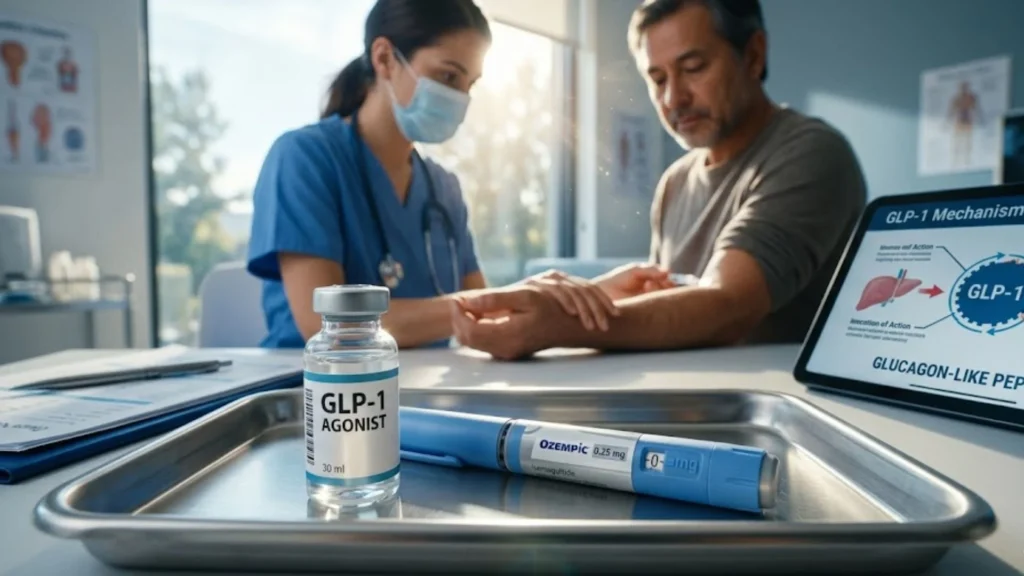
The injection sites matter too. Rotate between your belly, thigh, or arm. Pick a different spot each week to avoid bruises.
Stick to the dosage and administration schedule exactly. Do not double up if you miss a dose.
GLP-1 Cost and Insurance: The Brutal Reality
Let’s talk money.
The list price for GLP-1 drugs ranges from $936 to $1,349 a month. That is more than a car payment.
The cost per month breaks down like this:
- With insurance: $50–$150 (if covered).
- Without insurance: $500–$1,500.
- Cash-pay pharmacy programs: ~$499.
The insurance coverage is shrinking. Reuters reported that in 2025, employers are dropping coverage to save cash. Patients are skipping haircuts and vacations just to afford their meds.
If you need a prescription online for cheap, check LillyDirect or NovoCare. They offer home delivery for $499 flat.
GLP-1 Diet Plan: Eat Smart to Avoid the Puke
You cannot eat a cheeseburger on this drug.
Seriously.
High-fat foods trigger explosive diarrhea or vomiting because your stomach is emptying so slowly. You need a GLP-1 diet plan that respects the gastric emptying delay.
Follow the Balanced Plate model:
- 50% non-starchy veggies (broccoli, spinach).
- 25% lean protein (chicken, tofu).
- 25% complex carbs (quinoa, brown rice).
Drink water like it is your job. Constipation is a silent killer on these meds.
If you hit a weight loss plateau, increase your protein to 30 grams per meal. Add resistance training. Do not raise your dose without a doctor.
How to Get a GLP-1 Prescription Online
Yes, you can buy GLP-1 medication without leaving your couch.
How to get a prescription online is simple:
- Sign up for a telehealth platform like GoodRx for Weight Loss or Ro.
- Complete a medical questionnaire.
- Have a video visit with a licensed doctor.
- Get the prescription sent to a mail-order pharmacy.
Cost for the consult? About $39 to $99.
But warning: avoid shady sites offering “compounded” GLP-1 drugs. The FDA does not regulate those. You could be injecting mystery powder.
1. Is GLP-1 safe for weight loss?
Yes, for healthy adults with a BMI over 30. But it is not for everyone. Pregnant women and people with a thyroid cancer history should avoid it. Always ask your doctor first.
2. How fast does GLP-1 work?
You feel appetite suppression within 24 hours. Weight loss starts around week 4. Most peak results happen after 6 to 12 months.
3. What are GLP-1 side effects?
The most common are nausea, vomiting, diarrhea, and constipation. Rare risks include pancreatitis and gallbladder issues.
4. Who should take GLP-1 medications?
Adults with type 2 diabetes or obesity (BMI 30+). It is also for people with a BMI of 27+ who have weight-related health problems like high blood pressure.
5. Can GLP-1 help with obesity?
Yes. It is one of the most effective obesity treatment medications available. Clinical trials show it helps people lose 5% to 20% of their body weight.
Conclusion: Should You Try GLP-1?
Look, GLP-1 is a miracle for some and a nightmare for others.
If you have tried everything and your weight is hurting your health, talk to a doctor. But go in with open eyes.
You will lose weight. You will likely feel sick at first. You will pay a lot of money. And if you stop, the weight will probably come back.
It is a weight management therapy, not a cure. Use it as a tool, not a crutch. Pair it with real food and movement.
If you are ready, hit up a treatment provider today. But skip the drive-thru on the way home. Your stomach will thank you.
References
- Cochrane Library. (2025). *GLP-1 drugs effective for weight loss, but more independent studies needed*. Retrieved from https://www.cochrane.org/[reference:0]
- World Health Organization. (2025). *Obesity: GLP-1 therapies*. Retrieved from https://www.who.int/[reference:1]
- Medscape. (2025). Tirzepatide Tops Semaglutide for Weight Loss. Retrieved from https://www.medscape.com/[reference:2]https://www.womenshealthmag.com/[reference:3]
- Pharmacy Times. (2025). *FDA Approves First Oral GLP-1 for Weight Management*. Retrieved from https://www.pharmacytimes.com/[reference:4]
- GoodRx. (2025). *Yes, You Can Get GLP-1s Online — Here’s How*. Retrieved from https://www.goodrx.com/[reference:6]
Read More: PointClickCare
About the Author